
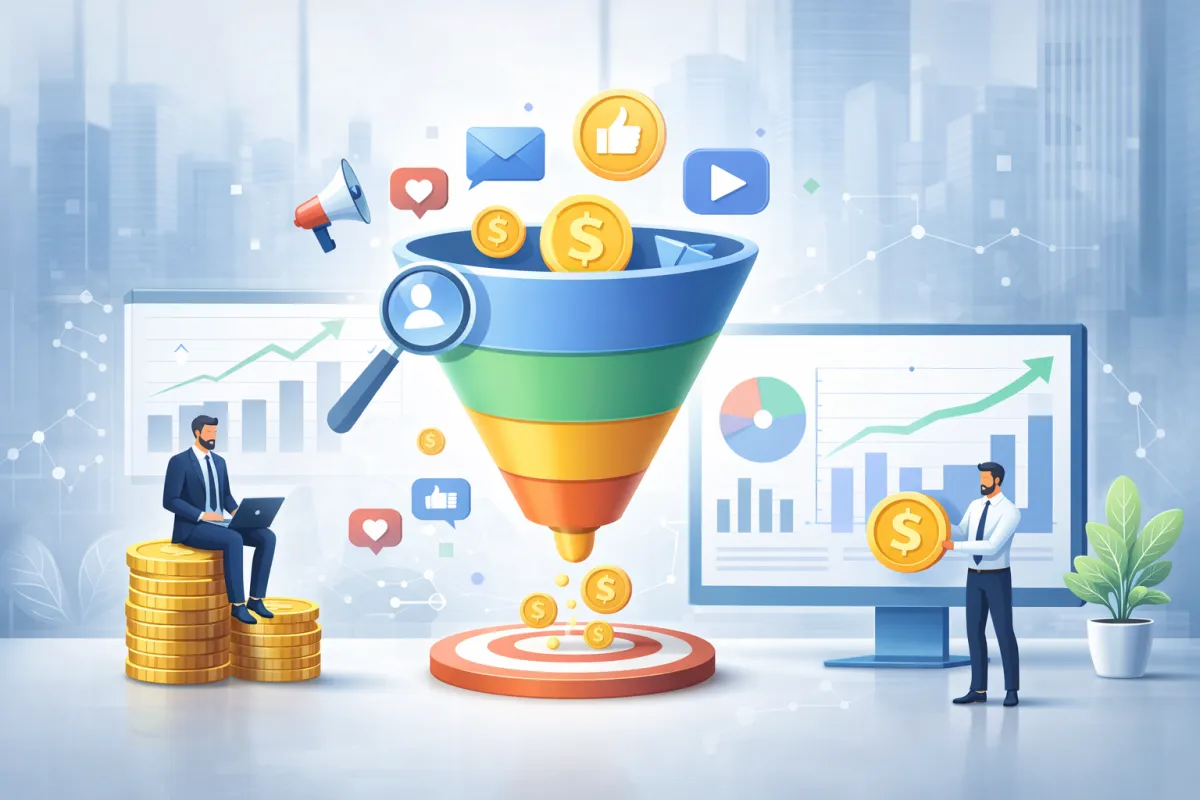
Why Small Businesses Should Build Sales Funnels Before Running Ads
For many small businesses, paid advertising feels like the fastest path to growth. Launch an ad campaign, drive traffic, and expect leads to follow.
In reality, advertising rarely fails because of the platform. It fails because there is no system behind it.
Running ads without a sales funnel forces traffic into a disconnected experience where visitors are expected to make decisions too quickly, with too little trust. A well-built sales funnel for small business growth changes that by creating a structured path from awareness to conversion.
Before investing in paid ads, businesses need to build the infrastructure that turns attention into revenue.
Understanding the Role of a Sales Funnel in Small Business Growth
A sales funnel is the process that guides potential customers from first interaction to conversion. It aligns marketing, messaging, and follow-up with how people actually make buying decisions.
Most customers do not buy on the first visit. They need clarity, trust, and reminders. A funnel accounts for this by mapping the full customer journey rather than focusing on a single transaction.
In practical terms, a sales funnel connects:
Traffic sources such as SEO, content marketing, or paid ads
Conversion points like landing pages or booking forms
Follow-up systems, including email, SMS, and CRM automation
Without this connection, traffic arrives and leaves without contributing to long-term growth.
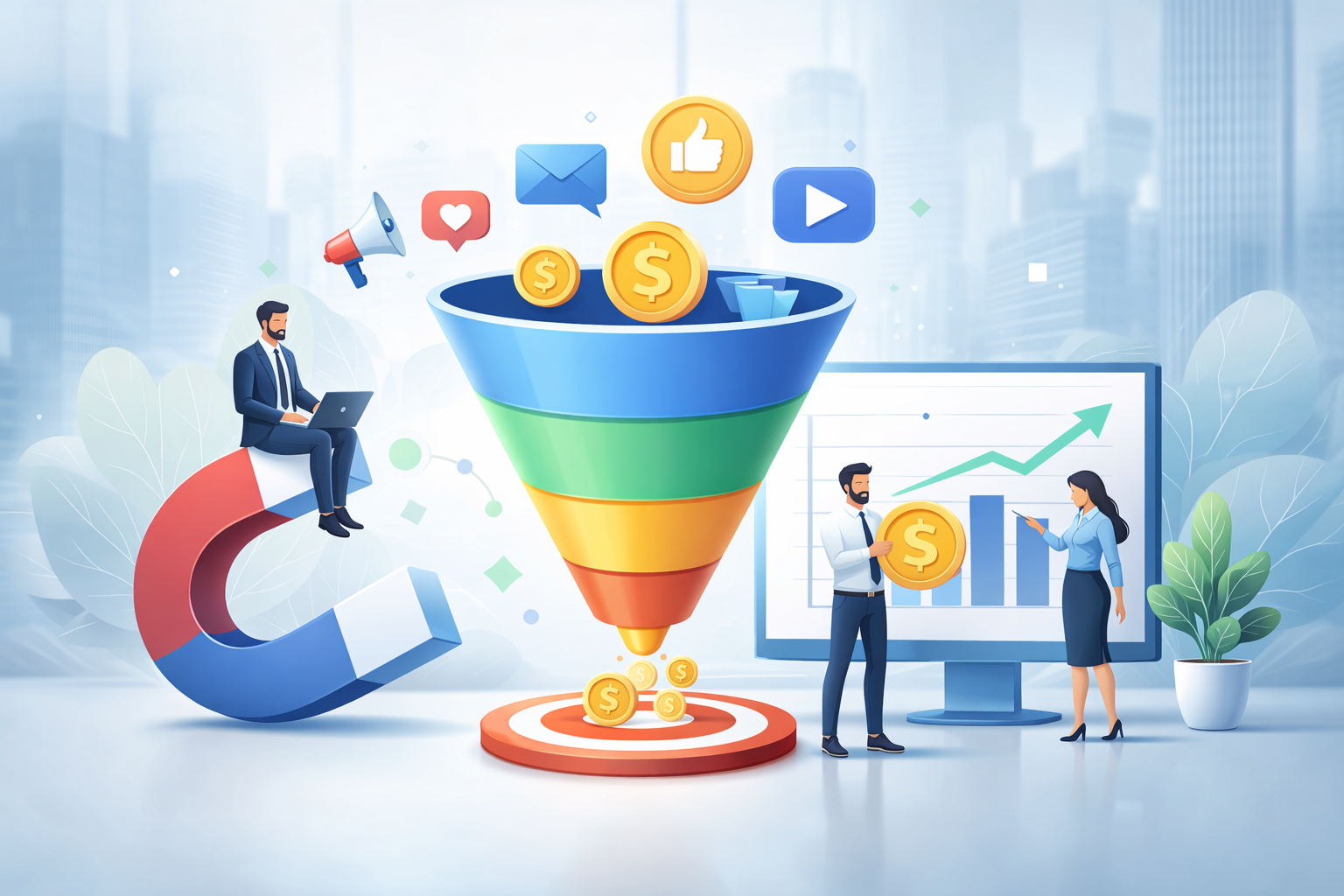
Why Paid Ads Fail Without a Funnel in Place
Paid ads generate attention, not trust. When small businesses send cold traffic directly to a homepage or service page, conversion rates stay low.
Industry data consistently shows that most websites convert only a small percentage of first-time visitors without structured lead nurturing. This means the majority of ad spend disappears after the initial click.
Common outcomes of running ads without a funnel include:
High cost per lead
Low conversion rates
No ability to re-engage visitors
No data on buyer behavior
Ads amplify whatever system exists. If there is no system, inefficiencies are amplified instead.
Sales Funnel vs Paid Ads: What Should Come First?
Small businesses often treat ads as the starting point. In reality, ads work best as a scaling tool after a funnel is proven.
Comparison: Ads First vs Funnel First
A funnel provides the foundation. Paid advertising then accelerates what already works.
How Sales Funnels Increase Advertising ROI
When a sales funnel is in place, paid traffic becomes significantly more valuable.
First, funnels convert anonymous visitors into leads. Instead of losing traffic, businesses build a database they can market to repeatedly without paying for every interaction.
Second, funnels enable automated lead nurturing. Email and SMS follow-ups allow businesses to stay visible, answer objections, and build trust over time.
Third, funnels unlock retargeting. Retargeting ads focus on people who already showed interest, which typically results in higher engagement and lower acquisition costs than cold advertising.
Finally, funnels provide measurable data. Businesses can track where prospects drop off and refine messaging, offers, and ad targeting based on real behavior.
What a Simple Pre-Ads Sales Funnel Looks Like
A sales funnel does not need to be complex to be effective. Most small businesses benefit from a clear, streamlined structure.
Example of a Basic Sales Funnel System
This structure allows traffic to move forward instead of stalling after the first interaction.
Common Sales Funnel Mistakes Small Businesses Make
Many businesses attempt to build funnels but fall into predictable traps.
One common issue is sending paid traffic to generic pages without a clear next step. Another is asking for the sale too early, before trust has been established.
Lack of follow-up is another major problem. Without CRM automation, most leads go cold quickly. Businesses also fail to track performance, making optimization impossible.
Sales funnels are not one-time setups. They are growth systems that improve over time with testing and data.
When Paid Advertising Makes Sense
Paid ads are most effective when the foundation is already built.
Small businesses should consider running ads once:
The ideal customer is clearly defined
A focused offer is in place
The funnel converts some traffic organically
Leads are tracked in a CRM
Follow-ups are automated
Conversion goals are measurable
Ads do not fix broken systems. They reveal them faster.
Funnels Create Predictable, Scalable Growth
Random marketing tactics lead to inconsistent results. Funnels create structure.
A properly built sales funnel connects SEO, content marketing, paid ads, and automation into a single growth system. This allows businesses to make decisions based on data instead of assumptions.
Over time, funnels reduce reliance on constant ad spend by increasing lifetime customer value and improving conversion efficiency.
This is the difference between marketing activity and engineered growth.
Final Thoughts
Running ads without a sales funnel is one of the most expensive mistakes small businesses make. Attention alone does not create revenue.
Sales funnels protect marketing spend, improve lead quality, and create predictable results. Once a funnel is working, paid advertising becomes a tool for scaling rather than an experiment.
Build the system first. Then use ads to accelerate growth.
That approach turns marketing into a long-term asset instead of a recurring expense.
Frequently Asked Questions
Do small businesses really need a sales funnel?
Yes. A sales funnel helps small businesses guide potential customers through the buying process, capture leads, and increase conversions instead of losing traffic after the first visit.
Can I run ads without a sales funnel?
You can, but it’s usually inefficient. Running ads without a funnel often leads to higher costs and low conversions because there’s no system to nurture or follow up with visitors.
What is the simplest sales funnel for a small business?
The simplest funnel includes a traffic source, a focused landing page, a lead capture form or booking option, and an automated follow-up sequence to nurture leads.
Do sales funnels improve ad performance?
Yes. Sales funnels typically improve ad ROI by capturing leads, enabling follow-ups, and supporting retargeting, which helps convert warm audiences at a lower cost.
When should a small business start running paid ads?
A small business should run ads after it has a clear offer, defined audience, lead tracking, and a basic funnel that already converts some traffic organically.